
|
|
The materials are fairly important to the successful outcome of the project. Where a certain material is recommended, it is because it has been found by experiment to work better, but if you are curious as to why, please e-mail your questions - all information is freely given. Some of the dimensions are deliberately designed to form Fibonacci ratios (these ratios are intimately entwined in the basic building blocks of life and seem to have almost magical properties - more Fibonacci details are to appear on this site soon). The details given here are adequate to build a one-person manteum enclosure, using a few standard tools.
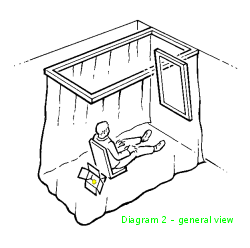
The manteum consists of a rectangular enclosure made using a heavy black fabric, which is hung from a simple wooden frame attached to the ceiling. The fabric reaches from ceiling to floor and can be fixed to the frame or attached to curtain rails to enable it to be slid out of the way for easy access (these instructions assume you will use rails since it is by far the better way). At one end of the enclosure, a large mirror is mounted on the wall. A comfortable chair is placed inside at a particular position facing the mirror, and a dim light in a box provides very low illumination from behind the chair. You may need to amend these instructions to suit available materials, but do try to follow them as closely as you can, especially the dimensions and the positioning of the various items - these are important if you want good results. Fabric: This needs to be fairly heavy if possible - black felt is ideal. If you can't see through it, it will do the job. The aim is to hang a series of "curtains" around the three open sides of the frame so as to form an enclosure. How much fabric you need depends on the width of the roll Fabrics come in different widths (150cms is ideal), so you'll have to work it out for yourself as follows. Simply divide 1500 by the width (in cms) of the roll available and round the result UP to the nearest whole number. For example if the roll is 150cms wide, divide 1500 by 150 which is 10, so you will need 10 lengths of material, each long enough to reach from floor to ceiling plus a little extra for hems. If for example your ceiling is 2.4 metres high, each length will need to be 2.5 metres long. So in this example you would need 25 metres of 150cms wide fabric. In addition you will need extra lengths to cover the top of the enclosure and the end wall. So if your fabric is 150cms wide, you will need a grand total of 30 metres in length, but it would be wise to allow a little extra for safety - say 32 metres. Back Frame: This is made from 8 metres of 50 x 50mm timber. Back Curtain rails: You will need around 6.5 metres of plastic (NOT metal) curtain rail complete with the usual runners and hooks. Back Mirror: New mirrors are expensive, so scour the free ads in the local newspaper for a large second-hand mirror, size around 90 x 120cms with a wooden frame. Back Chair: Here's the destructive bit! Find a comfortable chair, preferably with a little padding, and cut off the legs. Yes, cut its legs off, but make sure you choose a chair which stays in one piece without its legs. Back Lighting: A night light (the 7 watt type in a plastic case which plug directly into an electricity socket) is ideal. Make sure it is no brighter than 10 watts. You'll also need an extension lead and a cardboard box about 30 x 22 x 22cms. Back Tools: Drill, hammer, saw, screws and fixings, sewing machine. And lots of tea or coffee. Back
|


Copyright (c) 2001 All rights reserved.
webmaster@manteum.com